
- Project Overview
1.1 Project Background
Betel nut, as a specialty snack food, maintains stable market demand. Traditional betel nut packaging relies mainly on manual bagging and sealing, which suffers from low production efficiency, large measurement errors, difficult hygiene control, and high labor costs. As food industry regulations tighten and labor costs rise, building an automated and intelligent betel nut packaging production line has become an inevitable choice for enhancing enterprise competitiveness.
This plan addresses the packaging characteristics of betel nut products (irregular individual volume, requiring precise counting/weighing, dual-layer packaging of inner bag + outer bag, requiring coding for traceability), and designs a fully automated packaging production line from raw material feeding to finished palletizing, achieving labor reduction and efficiency improvement, controllable quality, and regulatory compliance.
1.2 Design Objectives
• Capacity target: Single line design capacity ≥ 120 bags/min (inner bags), daily capacity ≥ 250,000 bags (based on 20 hours)
• Measurement accuracy: Single bag weight error ≤ ±0.5%, counting accuracy ≥ 99.9%
• Staffing: Total line operators ≤ 4 per shift (including feeding, inspection, and boxing assistance)
• Qualification rate: First-pass yield of finished products ≥ 99.5%
• Compliance requirements: Meet the “General Rules for Food Production License Review (2022 Edition)” and the edible betel nut production license audit guidelines
1.3 Scope of Application
This plan applies to the entire process of inner bag packaging, outer bag packaging, boxing, and palletizing of finished edible betel nut products. It covers equipment selection, process layout, electrical control, hygiene design, capacity analysis, and investment estimation, and can serve as the technical basis for project initiation, equipment procurement, workshop renovation, and acceptance. - Design Basis and Implementation Standards
2.1 Regulations and Standards
No. Standard/Regulation Name Scope of Application
1 “General Rules for Food Production License Review (2022 Edition)” Production premises, equipment layout, process flow verification
2 “Edible Betel Nut Production License Audit Guidelines” Clean operation area zoning, equipment hygiene requirements
3 GB 14881-2013 “General Hygienic Standard for Food Production” Workshop layout, cross-contamination prevention
4 GB 5749-2022 “Standards for Drinking Water Quality” Production water
5 GB 2760-2024 “Standard for the Use of Food Additives” Packaging materials and auxiliary materials compliance
6 GB/T 19001-2016 / ISO 22000 Quality management system
7 GB 5009 Series Food microbiological and physicochemical testing
2.2 Design Principles
• Shortest process principle: Clear material flow, avoid detours and crossings, reduce handling distance
• Clean/dirty separation principle: Separate personnel and material flows, physical isolation between clean areas and general areas
• Scalability principle: Reserve upgrade interfaces at key workstations to support future capacity expansion
• Easy-to-clean principle: Equipment uses food-grade 304 stainless steel, no hygiene dead corners, quick-disassembly structure
• Data traceability principle: Full-line coding, batch, weight, and time data are queryable and traceable
3. Process Flow Design
3.1 Overall Process Flow
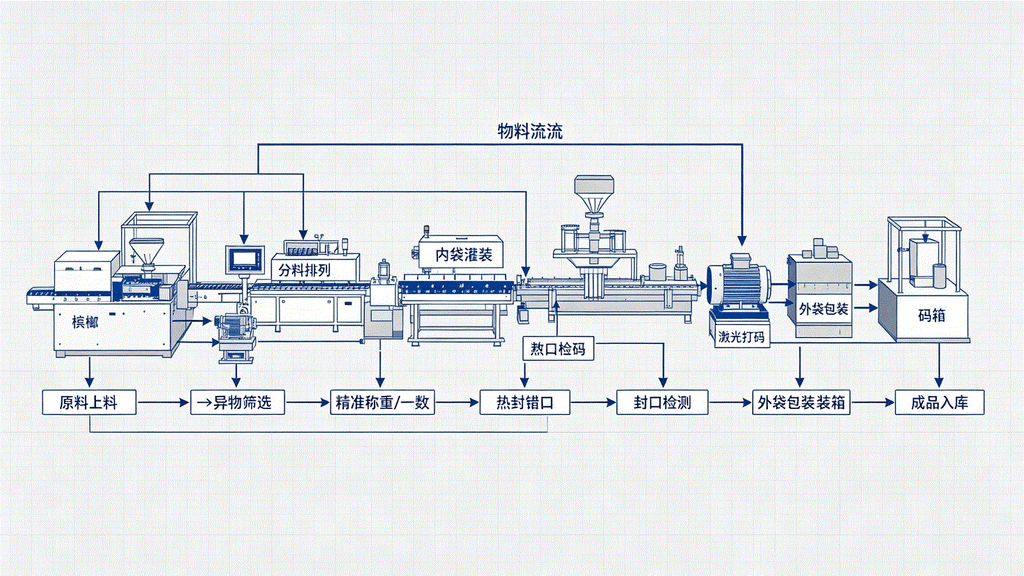
The betel nut packaging production line adopts a continuous process flow of “raw material feeding – screening and impurity removal – material distribution and alignment – precise measurement – inner bag filling and sealing – quality inspection – coding – outer bag packaging – boxing – palletizing – finished product warehousing”. Each process is seamlessly connected through conveyor belts, and inspection and rejection devices are set at key nodes to ensure non-conforming products do not flow into the next process.
Figure 1 Process Flow Diagram of Betel Nut Packaging Production Line
3.2 Description of Each Process
3.2.1 Raw Material Feeding and Screening/Impurity Removal
Betel nut semi-finished products are poured from turnover buckets into the hopper of a vibrating feeder, and uniformly fed to a CCD visual screening machine through a vibrating plate. The screening machine identifies the color, shape, size, and foreign matter (such as hair, metal debris, charred particles) of betel nuts through industrial cameras, and non-conforming products are automatically rejected by air nozzles. Screening accuracy ≥ 99.5%, processing capacity ≥ 300 pieces/min.
3.2.2 Material Distribution, Alignment and Precise Measurement
Qualified betel nuts are uniformly distributed by a distributor to a multi-head combination weigher (10-head or 14-head). The combination weigher uses high-precision weighing sensors (accuracy ±0.1g) and automatically matches the target weight through a combination algorithm, controlling single-bag weighing error within ±0.5%. For specifications sold by piece count, it can be switched to photoelectric counting mode with counting accuracy ≥ 99.9%.
3.2.3 Inner Bag Filling and Heat Sealing
A pouch-type inner packaging machine is used to automatically take bags, open bags, feed materials (betel nut + desiccant), exhaust air, heat seal, and shape. Heat sealing temperature 160-200°C adjustable, sealing width 8-12mm, sealing strength meets drop test requirements. The equipment has interlock protection functions of no feeding without bag, no dropping without bag opening, and no sealing without material. Packaging speed 80-120 bags/min.
3.2.4 Quality Inspection
After inner bag sealing, products pass through in sequence: ① Metal detector (detects ferrous/non-ferrous metals, sensitivity Fe ≥ φ1.0mm, SUS ≥ φ1.5mm); ② Weight recheck scale (dynamic weighing, automatic rejection of out-of-tolerance); ③ Sealing visual inspection (identifies sealing wrinkles, foreign matter entrapment, poor sealing). Any non-conformance in any of the three inspections results in automatic rejection and recording.
3.2.5 Coding and Outer Bag Packaging
Qualified inner bags are printed with production date, batch number, and traceability QR code by a laser coding machine (coding resolution ≥ 300DPI, speed ≥ 120 pieces/min). They then enter a rotary outer bag packaging machine, which automatically loads several inner bags (e.g., 10 packs/bag) into outer bags, vacuumizes/nitrogen-flushes, and heat seals. Outer bags also undergo sealing inspection and weight recheck.
3.2.6 Boxing and Palletizing
Outer bag finished products enter an automatic boxing machine via conveyor, automatically boxed, sealed, and labeled according to set specifications (e.g., 20 bags/box). After boxing, a palletizing robot stacks them onto pallets according to preset patterns, and full pallets are transported to the finished product warehouse by AGV or forklift. Palletizing capacity ≥ 600 boxes/hour, neat stacking pattern, stable interlayer staggering.
- Core Equipment Configuration Plan
4.1 Equipment Composition Overview
The entire production line consists of 9 core equipment units, each integrated and linked through conveyor belts and control systems. Equipment selection prioritizes domestic mature brands, while key components (servo motors, sensors, PLC) use international first-tier brands to ensure stability and maintainability.
Figure 2 3D Schematic Diagram of Betel Nut Packaging Production Line Equipment Composition
4.2 Main Equipment Parameter List
No. Equipment Name Key Parameters Quantity Material/Brand Requirements
1 Vibrating Feeder Storage capacity 50kg, adjustable feeding speed, variable frequency control 1 unit 304 stainless steel, food-grade
2 CCD Visual Screening Machine Camera ≥ 5MP, processing ≥ 300 pieces/min, rejection accuracy ≥ 99.5% 1 unit 304 stainless steel, industrial camera
3 Multi-head Combination Weigher 10/14 heads, accuracy ±0.1g, speed ≥ 120 times/min, IP65 1 unit 304 stainless steel, imported sensors
4 Pouch-type Inner Packaging Machine Bag width 80-200mm, speed 80-120 bags/min, servo drive 1 unit 304 stainless steel, PLC + touch screen
5 Metal Detector Fe ≥ φ1.0mm, SUS ≥ φ1.5mm, automatic rejection 1 unit 304 stainless steel, dual-channel
6 Dynamic Weight Recheck Scale Accuracy ±0.5g, speed ≥ 120 pieces/min, automatic rejection 1 unit 304 stainless steel, high-precision sensor
7 Laser Coding Machine Fiber/CO2 laser, resolution ≥ 300DPI, speed ≥ 120 pieces/min 1 unit Industrial grade, supports QR codes
8 Rotary Outer Bag Packaging Machine Rotary 8-12 stations, speed 40-60 bags/min, vacuum/nitrogen flushing 1 unit 304 stainless steel, servo drive
9 Automatic Boxing Machine Speed ≥ 10 boxes/min, automatic sealing and labeling, adjustable specifications 1 unit 304 stainless steel frame
10 Palletizing Robot Load ≥ 50kg, ≥ 600 boxes/h, 4-axis/6-axis, programmable stacking pattern 1 unit Industrial robot, including gripper
11 Conveyor System Belt/chain plate conveyor, variable frequency speed, food-grade belt 1 set 304 stainless steel frame
12 Central Control System PLC + touch screen + MES interface, full-line linkage, data acquisition 1 set Siemens/Mitsubishi PLC
4.3 Key Equipment Selection Notes
The multi-head combination weigher is the core equipment determining measurement accuracy. A 14-head configuration is recommended, offering higher combination flexibility and speed margin compared to 10-head. The pouch-type packaging machine should be a model with zipper opening function to accommodate betel nut stand-up zipper bag packaging needs. The outer bag packaging machine must be equipped with vacuum function to extend product shelf life. The palletizing robot should be a model with load capacity ≥ 80kg to reserve margin for future packaging specification increases.