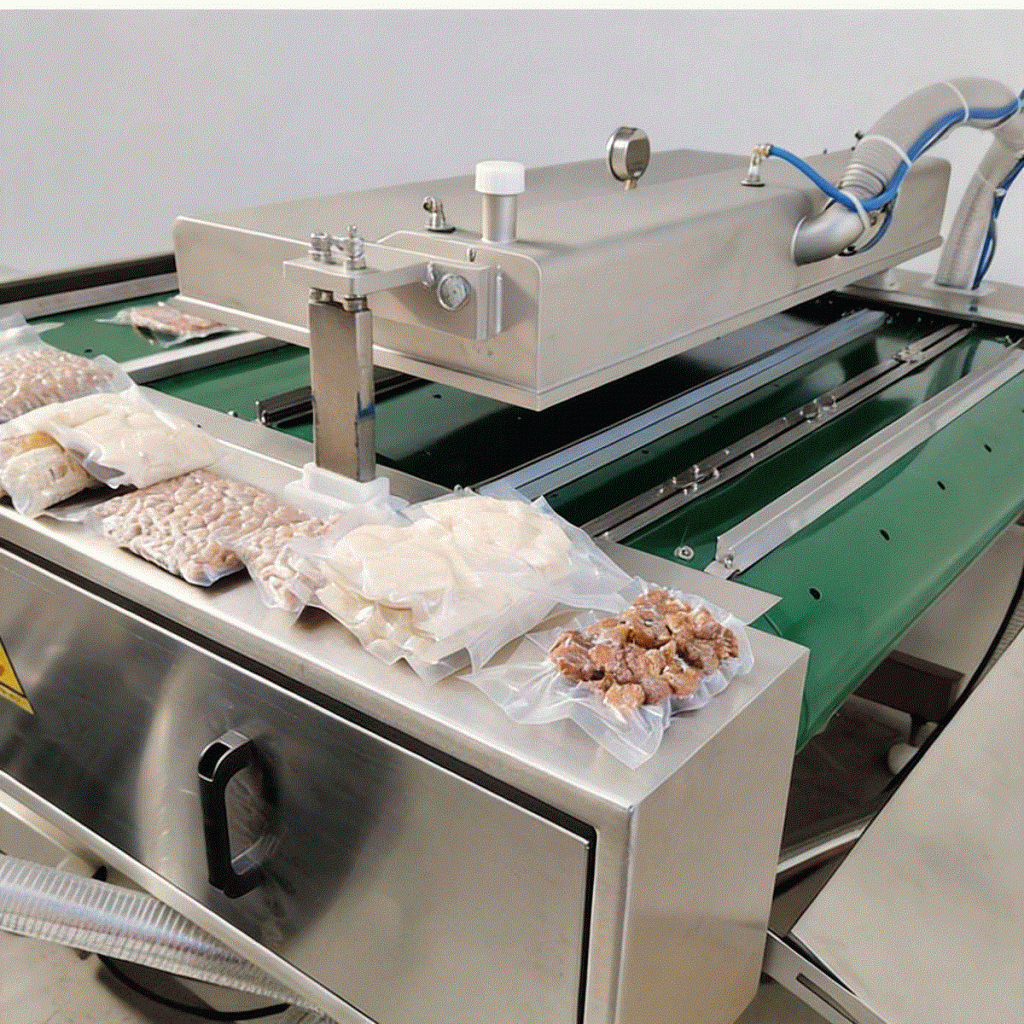
I. Essential Differences Between the Three Machine Types
| Dimension | Single Chamber | Double Chamber | Continuous (Roller/Chain-Belt) |
|---|---|---|---|
| Structure | 1 vacuum chamber, manual lid-open loading/unloading | 2 chambers sharing one vacuum pump, alternating operation | Conveyor belt + circulating chamber lids, automatic bag transport |
| Work rhythm | Evacuate → break vacuum → open lid → load/unload → re-close lid, with waiting time | While one chamber evacuates, the other is being loaded; minimal waiting | Bags travel continuously into the chamber on the belt; evacuation, sealing, and cooling complete in sequence |
| Typical capacity | 60–160 cycles/hour (~100–300 bags/hr) | 130–400 cycles/hour (~1.5–2× that of single chamber) | 300–1200+ bags/hour; high-speed lines can reach 2000+ bags/hr |
| Automation level | Fully manual loading/unloading | Manual loading/unloading but dual parallel chambers | Semi-automatic/full-automatic; can integrate upstream metering and downstream conveying |
| Footprint | Smallest (1–2 m²) | Medium (3–5 m²) | Largest; requires supporting air compression and feeding systems |
| Price range | ¥0.5–15K | ¥15–50K | ¥50–150K+ |
| Suitable scenarios | Retail stores, workshops, e-commerce, labs, multi-variety small-batch | Medium-scale lines for braised food plants, meat processors, prepared-food (预制菜) plants (thousands of packs/day) | Large-scale slaughtering, quick-frozen, and prepared-food production lines (tens of thousands of packs/day) |
Key point: both single-chamber and double-chamber machines are “batch chamber machines”; the only difference is that the double chamber uses two chambers to hide the manual loading time. A continuous machine is a different structure (conveyor belt + circulating chambers), not simply “a double chamber upgraded one level.”
II. Can Continuous Replace Single and Double Chamber?
Not completely — it’s a layered substitution:
- The continuous type does genuinely replace double-chamber in “large-volume, standardized, assembly-line” scenarios — e.g., large frozen-food, portioned-meat, and pickled-vegetable plants, where double-chamber can’t keep up with the pace.
- But for small batches, many SKUs, high-liquid-content products, irregular shapes, and in-store packaging, the continuous type is actually unsuitable:
- Changeover/adjustment for different specifications is troublesome; the belt pace is fixed, so small orders run idle and waste electricity;
- Products with lots of soup/liquid tend to accumulate liquid in continuous rolling machines, affecting sealing; double chambers can be fitted with inclined chambers;
- The single chamber wins on low cost, portability, and the ability to start with just a few thousand yuan — workshops and restaurant stores will always need it.
So the industry pattern is “single chamber as complement + double chamber as mainstay mid-tier + continuous as the top end for scale” — all three coexist. A double chamber can also be used as a single chamber (by shutting off one chamber), but it is not a continuous machine.
III. Market Share (China, 2025 basis; note differences in statistical scope)
There is no unified official data on the single/double/continuous three-way split in China; the following is estimated by piecing together several industry reports:
- Overall market size: In 2025, the Chinese vacuum packaging machine market (including food-grade) was approximately USD 8.9–9.3 billion (broad equipment scope); looking only at food vacuum packaging machines, it’s around USD 3.5 billion (~RMB 35 billion).
- Single chamber: Penetration is very high among small and medium food factories — one report puts single-chamber penetration at 63% in small/mid plants. By unit count, single chamber has the largest share (cheap, frequent repeat purchases), but by value it’s diluted by double-chamber and continuous machines. Rough estimate: ~40–45% by unit count, ~20–25% by value.
- Double chamber: Around 36% of industrial packaging facilities prefer double chamber (Global Growth Insights, food vacuum skin-packaging segment scope); domestic equipment-value share is estimated by industry insiders at about 22%. Double chamber is the “backbone” — fewer units than single chamber, but higher value per unit.
- Continuous (including roller, chain-belt, and form-fill-seal integrated machines): In segments like dairy, the continuous type already exceeds 55% share; overall value share is rising with automation upgrades — roughly 30–35% by value, 10–15% by unit count (high unit price inflates the value share).
- The remaining share is split among external-suction (nozzle) vacuum machines, thermoforming (tray) machines, pre-made-bag full-automatic lines, big-bag (ton-bag) machines, and others.